This manual details the installation of the Honeywell TH6000R1003 thermostat, covering wiring, mounting, setup, and advanced features. It’s designed for qualified HVAC professionals.
Overview of the TH6000R1003 Thermostat
The Honeywell TH6000R1003 is a programmable thermostat, part of the FocusPRO 6000 Series, designed for efficient home climate control. It supports various HVAC systems, offering features like programmable schedules, compressor protection, and adaptive intelligent recovery. This model, detailed in manuals like 69-2427EFS-01 and 69-1921EFS-03, provides flexible operation with manual or automatic changeover options.
Its user interface allows for customized settings, enhancing comfort and energy savings.
Target Audience for this Installation Manual
This installation manual is specifically intended for qualified and experienced HVAC (Heating, Ventilation, and Air Conditioning) professionals. It assumes a working knowledge of electrical systems, HVAC equipment, and safety procedures. While homeowners may find some information useful, professional installation is strongly recommended to ensure correct operation and avoid potential hazards.
Understanding wiring diagrams and system configurations is crucial for those utilizing this guide.
Pre-Installation Considerations
Before beginning, prioritize safety, gather necessary tools, and verify all package contents are present. Proper preparation ensures a smooth installation process.
Safety Precautions
Prior to installation, disconnect power to the HVAC system at the breaker panel to avoid electrical shock. Improper wiring can damage the thermostat or system.
Only qualified personnel should perform this installation. Always follow local electrical codes and regulations.
Ensure the work area is clean and well-lit.
Wear appropriate personal protective equipment (PPE), including safety glasses.
If you are uncomfortable with any aspect of the installation, consult a professional HVAC technician.
Failure to adhere to these precautions could result in injury or property damage.
Tools Required for Installation
For a successful Honeywell TH6000R1003 installation, gather these tools: a Phillips head screwdriver, a flathead screwdriver, wire strippers, a wire connector tool, a level, a drill with appropriate bits (for mounting), and a voltage tester.
A digital multimeter is helpful for verifying power is off.
Pencil for marking mounting locations.
Safety glasses are essential.
Ensure all tools are in good working condition before starting the installation process. Having these tools readily available streamlines the setup.
Package Contents Verification
Upon receiving the Honeywell TH6000R1003, verify all components are present. The package should include the thermostat display unit, a mounting base plate, screws and wall anchors for mounting, wire labels, and this installation manual.
Confirm the remote controller (MRCH1), if included, is also present.
Inspect all items for any shipping damage.
If any parts are missing or damaged, immediately contact Honeywell Customer Support for replacements before proceeding with the installation.
Wiring and Connections
Proper wiring is crucial for correct operation. This section details terminal designations, HVAC system connections, wiring diagrams, and best practices.
Identifying Terminal Designations
Understanding terminal labels is essential for a successful installation. Common terminals include R (power), C (common), W (heat), Y (cool), and G (fan). Refer to your specific HVAC system’s wiring diagram for accurate identification. The TH6000R1003 supports various system configurations, including conventional and heat pump setups. Incorrect wiring can damage the thermostat or HVAC equipment. Always double-check connections before powering on the system. Detailed diagrams are provided to assist with proper terminal assignment, ensuring compatibility and optimal performance.
Connecting the Thermostat to HVAC System
Carefully connect the thermostat wires to the corresponding terminals on your HVAC system’s control board. Ensure the system’s power is OFF before commencing any wiring. Use appropriately sized wire connectors for secure connections. Follow the wiring diagrams specific to your HVAC type – conventional or heat pump. Double-check all connections against the terminal designations. A loose connection can cause malfunctions. Proper grounding is crucial for safety and reliable operation. Verify wiring before restoring power to avoid potential damage.
Wiring Diagrams for Different HVAC Systems
The TH6000R1003 supports various HVAC configurations. Diagrams are essential for correct wiring. Conventional systems utilize wiring for heating, cooling, and a common wire. Heat pump systems require additional wiring for reversing valve control and auxiliary heat. Refer to the detailed diagrams in the installation manual for specific terminal connections. Incorrect wiring can damage the thermostat or HVAC equipment. Always verify the diagram matches your system before connecting wires. Professional installation is recommended for complex setups.
Low Voltage Wiring Best Practices
Employing proper low-voltage wiring techniques is crucial for reliable thermostat operation. Use appropriately sized wire (typically 18-22 gauge) and ensure secure connections at all terminals. Avoid sharp bends or kinks in the wiring. Keep low-voltage wires separate from high-voltage wiring to prevent interference. Label each wire clearly for easy identification during troubleshooting. A clean, organized wiring layout enhances serviceability and minimizes potential issues. Always double-check connections before powering on the system.
Thermostat Mounting
Securely mounting the thermostat is essential for accurate readings and reliable operation. This section details selecting a location and properly attaching the base plate and display.
Selecting a Suitable Mounting Location
Choosing the right location is crucial for optimal thermostat performance. Avoid direct sunlight, drafts, and proximity to heat-generating appliances. The ideal spot is on an interior wall, approximately five feet from the floor, in a frequently occupied room.
Ensure the location is representative of the overall home temperature and away from areas with poor air circulation. Do not mount near exterior doors or windows, as these can cause inaccurate temperature readings. Consider accessibility for future maintenance and adjustments when finalizing the mounting position.
Mounting the Thermostat Base Plate
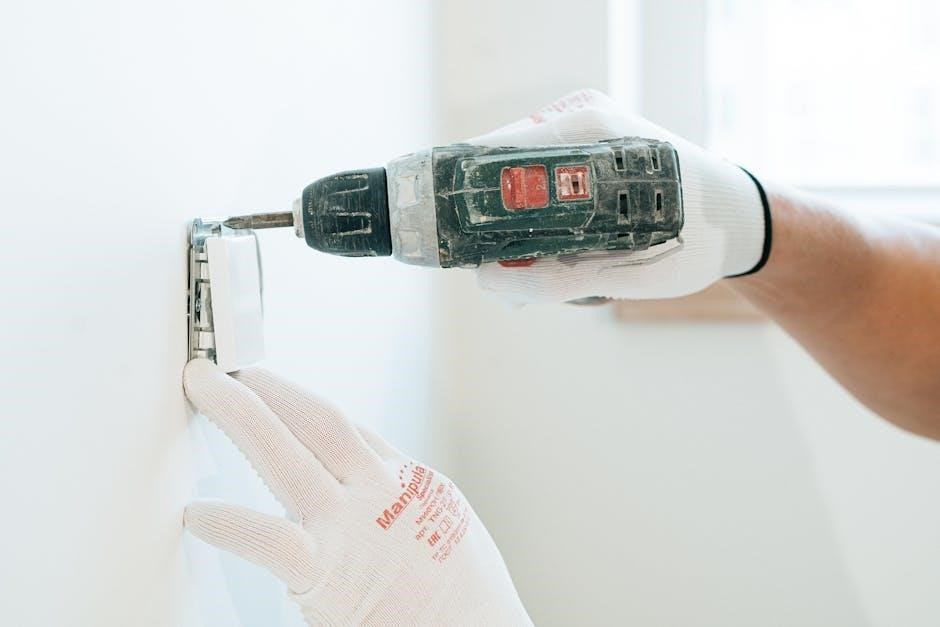
Before mounting, ensure power to the HVAC system is completely OFF at the breaker. Using the base plate as a template, mark the screw holes on the wall. Drill pilot holes if necessary, using appropriate wall anchors for secure attachment.
Carefully align the base plate with the marked holes and fasten it to the wall using the provided screws. Ensure the base plate is level for proper thermostat display alignment. Gently push any excess wiring back into the wall opening.
Attaching the Thermostat Display Unit
With the base plate securely mounted, carefully align the thermostat display unit with the base. Gently push the display unit onto the base plate until it clicks into place, ensuring a snug and secure connection.
Verify the display unit is firmly attached and level. Do not force the unit; if it doesn’t seat easily, check for obstructions. Once attached, the thermostat is ready for power-up and initial configuration.
Initial Setup and Configuration
Power on the thermostat and follow the on-screen prompts to set the date, time, and system type (heat, cool, or auto) for optimal performance.
Powering On the Thermostat
After completing the wiring connections, ensure the HVAC system’s power switch is turned off before proceeding. Once wiring is verified, restore power to the system. The Honeywell TH6000R1003 thermostat should automatically power on and display the welcome screen. If it doesn’t, double-check the wiring, particularly the common (C) wire connection, as this is crucial for consistent power.
A lack of a ‘C’ wire is a common cause of power-up issues. If the display remains blank, consult the wiring diagrams or a qualified HVAC technician for assistance. The initial startup may take a few moments as the thermostat calibrates.
Setting the Date and Time
Upon powering on, the Honeywell TH6000R1003 will likely prompt you to set the current date and time. Navigate through the thermostat’s menu using the up and down arrow buttons. Select the year, month, day, hour, and minute, confirming each selection. Accurate date and time settings are essential for proper scheduling and operation of programmable features.
Incorrect time settings can lead to inaccurate temperature control and scheduling. Ensure the time zone is also correctly configured for your location. Refer to the thermostat’s display for specific instructions on accessing and modifying these settings.
Configuring System Type (Heat/Cool/Auto)
After setting the date and time, the Honeywell TH6000R1003 requires configuration of your HVAC system type. Access the system settings menu and select from options like Heat, Cool, or Auto. ‘Heat’ is for heating-only systems, ‘Cool’ for cooling-only, and ‘Auto’ allows the thermostat to switch between heating and cooling as needed.
Selecting the correct system type ensures proper operation. Incorrect settings can cause the system to run inefficiently or not at all. Consult your HVAC system’s documentation if unsure which setting to choose.
Programming the Thermostat
The TH6000R1003 allows customizable schedules for temperature control. Users can create, edit, and utilize temporary or permanent holds for optimal comfort and efficiency.
Understanding Programmable Schedules
The Honeywell TH6000R1003 thermostat utilizes programmable schedules to automate temperature adjustments throughout the day. These schedules are broken down into periods – typically Wake, Leave, Return, and Sleep – allowing for customized settings during different times. Each period can be assigned a specific temperature for heating and cooling.
Understanding these periods and their corresponding times is crucial for efficient energy usage and personalized comfort. The thermostat supports different schedules for weekdays and weekends, offering flexibility to accommodate varying routines; Properly configured schedules minimize energy waste while ensuring a comfortable indoor environment.
Creating and Editing Schedules
To create or edit schedules on the TH6000R1003, navigate to the programming menu using the thermostat’s interface. You can define start times and temperatures for each period (Wake, Leave, Return, Sleep) individually. The system allows for copying schedules between days to streamline the setup process.
Modifications are easily made by selecting the desired period and adjusting the time or temperature settings. Remember to save changes after editing. The thermostat’s intuitive design simplifies schedule management, ensuring optimal comfort and energy savings.
Temporary and Permanent Holds
The Honeywell TH6000R1003 offers both temporary and permanent hold functions for overriding programmed schedules. A temporary hold maintains a set temperature until the next scheduled period, reverting automatically. To activate, simply adjust the temperature and select the ‘Hold’ option.
A permanent hold, conversely, keeps the selected temperature indefinitely, disregarding the programmed schedule until manually canceled. This is ideal for extended periods away or consistent comfort preferences. Access these options via the thermostat’s main menu.
Advanced Features
The TH6000R1003 boasts compressor protection, adaptive intelligent recovery, and customizable fan control options, enhancing system efficiency and user comfort significantly.
Compressor Protection Settings
Compressor protection is a crucial feature preventing short-cycling and extending compressor lifespan. The Honeywell TH6000R1003 allows configuration of minimum on-times, typically adjustable between 3 and 10 minutes.
This setting ensures the compressor runs for a sufficient duration before cycling off, reducing stress. Improper settings can lead to inefficiency or damage. Refer to the HVAC system manufacturer’s recommendations for optimal cycle rate (CPH) settings. Carefully consider the system’s specific requirements when configuring this feature for peak performance and longevity.
Adaptive Intelligent Recovery Configuration
Adaptive Intelligent Recovery optimizes comfort by learning the HVAC system’s heating/cooling rates. This feature proactively adjusts start times to reach the desired temperature precisely when scheduled.
The TH6000R1003’s algorithm analyzes past performance, adapting to home insulation and external conditions. Configuration options typically include on/off or adjustable recovery time settings. Enabling this feature minimizes temperature swings and enhances overall energy efficiency, providing consistent comfort without manual adjustments. Proper setup ensures optimal performance.
Fan Control Options (On/Auto)
The Honeywell TH6000R1003 offers two primary fan control modes: On and Auto. In ‘Auto’ mode, the fan operates solely during heating or cooling cycles, optimizing energy use and maintaining consistent temperatures. Selecting ‘On’ mode ensures continuous fan operation, promoting air circulation and potentially improving air quality.
Users can easily switch between these modes via the thermostat interface. Continuous fan operation can also help distribute conditioned air more evenly throughout the home, enhancing comfort levels.
Troubleshooting Common Issues
This section addresses frequent problems like power failures, inaccurate readings, and communication errors with the HVAC system, offering solutions for quick resolution.
Thermostat Not Powering On
If the thermostat fails to power on, first verify the circuit breaker supplying power to the HVAC system is active. Confirm the thermostat wiring is secure and correctly connected to the HVAC system’s terminals, referencing the appropriate wiring diagram.
Check for a disconnected or damaged ‘C’ wire (common wire), as this is crucial for consistent power. Utilize a multimeter to test voltage at the thermostat terminals, ensuring adequate power delivery. If issues persist, consult a qualified HVAC technician for further diagnosis and repair, potentially involving the transformer.
Incorrect Temperature Readings
If the thermostat displays inaccurate temperatures, initially ensure it isn’t directly exposed to sunlight, drafts, or heat-generating appliances. Verify proper airflow around the unit isn’t obstructed. Utilize the thermostat’s calibration feature, accessible through the settings menu, to adjust the temperature reading.
If calibration doesn’t resolve the issue, inspect the thermistor sensor for damage or loose connections. Consider a factory reset as a troubleshooting step; however, consult a professional if discrepancies continue.
Communication Errors with HVAC System
Experiencing communication failures between the thermostat and your HVAC system often indicates wiring issues. Double-check all connections at the thermostat and the HVAC control board, ensuring secure and correct terminal assignments. Verify the HVAC system’s power supply is stable and meets the thermostat’s requirements.
If problems persist, inspect the thermostat’s wiring for shorts or breaks. A professional HVAC technician should diagnose complex communication problems involving the control board.
Factory Reset and Calibration
Restoring factory settings clears custom configurations. Temperature calibration adjusts readings for accuracy, ensuring optimal comfort and system performance. Refer to the manual for procedures.
Performing a Factory Reset
A factory reset returns the Honeywell TH6000R1003 thermostat to its original, out-of-the-box settings. This process erases all personalized programming, schedules, and configurations. It’s useful for troubleshooting, preparing the thermostat for a new user, or resolving persistent operational issues.
Typically, this involves accessing the thermostat’s settings menu and selecting the “Factory Reset” or “Default Settings” option. Confirm the action, as all custom data will be lost. Following the reset, you’ll need to reconfigure the thermostat, including date, time, system type, and desired schedules.
Temperature Calibration Procedures
Temperature calibration adjusts the thermostat’s displayed temperature to match a known accurate reference. If discrepancies exist between the thermostat reading and a trusted thermometer, calibration is necessary. Access the thermostat’s settings menu, locating the “Calibration” or “Temperature Offset” function.
Adjust the value in small increments (e.g., 1°F) until the thermostat accurately reflects the reference temperature. Verify the calibration with the trusted thermometer. Accurate calibration ensures efficient HVAC operation and user comfort.
Remote Controller (MRCH1) Setup
The MRCH1 remote controller enhances convenience. Pairing involves accessing the thermostat’s settings and initiating the pairing mode, as detailed in the user manual.
Pairing the Remote Controller
To pair the MRCH1 remote controller with your Honeywell TH6000R1003 thermostat, begin by ensuring the thermostat is powered on and in a normal operating mode. Navigate to the thermostat’s menu, typically accessed through the system settings. Select the option related to remote control or accessory pairing.
The thermostat will then enter a discovery mode, searching for the MRCH1. Simultaneously, initiate the pairing process on the remote controller itself – consult the remote’s manual for specific button combinations. Once detected, the thermostat will display a confirmation message, and the remote will be successfully linked, enabling convenient control from a distance.
Remote Controller Functionality Overview
The Honeywell MRCH1 remote controller provides convenient, wireless control of your TH6000R1003 thermostat. Key functions include adjusting the setpoint temperature for both heating and cooling modes, changing system operation between Heat, Cool, Auto, and Off. Users can also view the current room temperature and humidity levels directly on the remote’s display.
Furthermore, the remote allows access to programmed schedules, temporary holds, and fan control settings, mirroring the thermostat’s core functionalities for enhanced user convenience and accessibility throughout the home.
Software Updates and Maintenance
Regularly check for software updates to ensure optimal performance and access to new features; Clean the thermostat with a dry cloth for longevity.
Checking for Software Updates
To verify if a software update is available for your Honeywell TH6000R1003 thermostat, navigate through the thermostat’s menu system. Access the settings, then locate the “About” or “Information” section. Within this area, there should be an option to “Check for Updates.”
The thermostat will then connect to Honeywell’s servers to determine if a newer version of the software exists. If an update is found, follow the on-screen prompts to download and install it. Ensure a stable power connection during the update process to prevent interruptions.
Cleaning and Maintaining the Thermostat
Regular cleaning ensures optimal performance of your Honeywell TH6000R1003 thermostat. To clean, gently wipe the display unit with a soft, dry cloth. Avoid using liquid cleaners or abrasive materials, as these can damage the screen; The thermostat baseplate requires minimal maintenance.
Periodically check for dust accumulation around the vents. Use a small brush or vacuum cleaner attachment to remove any debris; Do not disassemble the thermostat for cleaning, as this may void the warranty.

Technical Specifications
The TH6000R1003 operates within 32-104°F, requires 24VAC power, and measures approximately 4.9″ x 3.1″ x 1.2″, weighing under one pound.
Operating Temperature Range
The Honeywell TH6000R1003 thermostat is designed to function reliably within a specified ambient temperature range. Optimal performance is generally achieved when the surrounding environment falls between 32°F and 104°F (0°C and 40°C).
Operating outside of this range may lead to inaccurate temperature readings or potentially affect the thermostat’s ability to correctly control the HVAC system. Exposure to temperatures significantly below freezing or excessively high heat should be avoided to ensure longevity and consistent operation.
Power Requirements
The Honeywell TH6000R1003 thermostat operates on 24VAC (Volts Alternating Current), commonly supplied by the HVAC system’s control transformer. It’s crucial to verify the HVAC system provides a stable 24VAC power source before installation.
The thermostat’s power consumption is relatively low, typically around 3 Watts. Do not connect the thermostat to a higher voltage source, as this could cause permanent damage and void the warranty. Proper wiring is essential for safe and reliable operation.
Dimensions and Weight
The Honeywell TH6000R1003 thermostat’s dimensions are approximately 4.7 inches (width) x 3.1 inches (height) x 1.2 inches (depth). These compact dimensions allow for versatile mounting options on various wall types.
The unit’s weight is around 0.5 pounds (approximately 227 grams), making it lightweight and easy to handle during installation. These specifications are important for planning the installation location and ensuring proper fit.

Warranty Information
Honeywell provides a warranty covering defects in materials and workmanship. Contact Honeywell Customer Care for specific coverage details and claim procedures.
Warranty Coverage Details
Honeywell’s warranty for the TH6000R1003 thermostat typically covers defects in materials and workmanship for a specified period from the date of installation, contingent upon proper installation and use as outlined in this manual. The warranty excludes damage resulting from misuse, abuse, accidents, unauthorized modifications, or improper maintenance.
Coverage may include repair or replacement of the defective thermostat at Honeywell’s discretion. Proof of purchase, including the installation date, is required for all warranty claims. This warranty provides limited remedies, and Honeywell is not liable for consequential or incidental damages.
Contacting Honeywell Customer Support
For assistance with your Honeywell TH6000R1003 thermostat, reach out to Honeywell Customer Care for technical support, warranty inquiries, or general questions. You can typically find contact information – including phone numbers and online resources – on the Honeywell Home website or within the product documentation.
Be prepared to provide your thermostat model number and date of purchase when contacting support. Online resources often include FAQs, troubleshooting guides, and downloadable manuals to help resolve common issues quickly and efficiently.



0 Comments