Exodus Book Summary: A Comprehensive Guide (PDF Focus)
Exodus details Israel’s liberation from Egyptian slavery under Moses’ leadership, and God’s covenant establishment.
PDF resources offer in-depth study of plagues, the Passover, and laws received at Sinai.
Explore themes of redemption and divine presence.
Exodus, the second book of the Hebrew Bible, dramatically narrates the Israelites’ journey from slavery in Egypt to their formation as a nation under God’s covenant. The name “Exodus,” derived from the Greek translation of the Hebrew term meaning “departure,” aptly captures the book’s central theme: liberation. This pivotal narrative isn’t merely a historical account; it’s a foundational story for understanding God’s character, His commitment to His people, and the principles of redemption.
The book builds upon the narrative established in Genesis, picking up with the descendants of Jacob (Israel) residing in Egypt. Initially welcomed, they eventually face harsh oppression and enslavement under a new Pharaoh who fears their growing numbers. Moses emerges as God’s chosen leader, tasked with confronting Pharaoh and leading the Israelites to freedom;
Exodus is rich in theological significance, revealing God’s power through the ten plagues inflicted upon Egypt, His faithfulness in providing for His people during their wilderness wanderings, and His holiness demonstrated through the giving of the Law at Mount Sinai. PDF study guides often focus on these key events, offering detailed analyses of the plagues, the Passover ritual, and the significance of the Ten Commandments. Understanding Exodus is crucial for grasping the entire biblical narrative and its message of hope and deliverance.
Historical Context and Authorship
Determining the precise historical context of Exodus remains a complex undertaking. While the book recounts events traditionally dated to the 15th century BC (during the New Kingdom period of Egypt), archaeological evidence directly corroborating the Exodus narrative is debated among scholars. The timeframe is often linked to the reign of Pharaohs like Thutmose III or Ramesses II, though definitive proof remains elusive.

Traditionally, Moses is considered the author of Exodus, along with the first five books of the Bible (the Pentateuch or Torah). However, modern scholarship suggests a more nuanced understanding. It’s likely that the text evolved over time, with contributions from various sources and editors. Lawrence Boadt notes that the explicit attribution to Moses solidified after the Babylonian exile in 539 BC.
PDF resources exploring the historical context often delve into the socio-political conditions of ancient Egypt and Canaan, examining potential parallels between biblical accounts and extra-biblical sources. Analyzing the legal codes and covenant structures within Exodus also provides insights into the cultural and religious landscape of the ancient Near East. Understanding these factors enhances our appreciation of the book’s historical and theological significance, even amidst ongoing scholarly debate.
The Growth of Jacob’s Family in Egypt (Exodus 1:1-7)
Exodus 1:1-7 details the Israelites’ settlement in Egypt after Joseph, having risen to power, welcomed his family. Jacob (Israel) and his descendants, numbering seventy individuals, were granted the land of Goshen, a fertile region. This initial period is characterized by prosperity and rapid population growth.
The text emphasizes the fulfillment of God’s promise to Abraham – that his descendants would become a great nation. Despite being foreigners in a new land, the Israelites flourished, multiplying greatly “and the land was filled with them.” This demographic expansion is crucial, setting the stage for the subsequent conflict with a new Pharaoh who did not know Joseph.
PDF study guides often highlight this section as foundational to understanding the narrative’s trajectory. The Israelites’ increasing numbers represent both a blessing and a potential threat in the eyes of the new Egyptian ruler. This sets the stage for the oppression described in the following verses, and ultimately, the need for divine intervention. The initial peaceful integration contrasts sharply with the impending bondage.
Israelites’ Bondage in Egypt (Exodus 1:8-22)
Exodus 1:8-22 narrates the shift in Egyptian policy towards the Israelites, marked by increasing oppression and forced labor. A new Pharaoh, unfamiliar with Joseph’s legacy, perceived the growing Israelite population as a threat to national security. He implemented harsh decrees, subjecting them to brutal tasks like building supply cities – Pithom and Raamses.
Despite the intensified hardship, the Israelites continued to multiply, frustrating Pharaoh’s attempts to control their numbers. This led to an even more drastic measure: the order to kill all newborn Hebrew male infants, casting them into the Nile River. This act of infanticide demonstrates the Pharaoh’s ruthless determination to suppress the Israelite population.
PDF resources emphasize this section as a pivotal moment, illustrating the depths of human cruelty and the Israelites’ desperate plight. However, it also highlights God’s providential care, as He prepares to deliver His people. The midwives, Shiphrah and Puah, defy Pharaoh’s command, fearing God and preserving the lives of Hebrew babies, showcasing early acts of resistance and faith.
Moses’ Birth and Early Life (Exodus 2:1-10)
Exodus 2:1-10 details the miraculous birth of Moses amidst the decree to kill Hebrew infants. His mother, concealing him for three months, eventually places him in a waterproof basket among the reeds of the Nile, entrusting him to God’s protection. Pharaoh’s daughter discovers the baby and, moved with compassion, adopts him, naming him Moses – meaning “drawn out” – recognizing his rescue from the water.
Moses is raised as an Egyptian prince, receiving a privileged education and upbringing within Pharaoh’s household. However, PDF study guides emphasize that this was all part of God’s plan. Despite his royal status, Moses remains aware of his Hebrew heritage, a crucial element in his future role as a deliverer.
The narrative highlights a pivotal moment when Moses intervenes to defend a Hebrew slave being beaten by an Egyptian. This act, though motivated by righteous anger, forces Moses to flee Egypt to avoid Pharaoh’s wrath, setting the stage for his next chapter in Midian. This section underscores God’s preparation of Moses for his future leadership.
Moses Flees to Midian (Exodus 2:11-25)
Following his act of defending a Hebrew slave, Moses flees Egypt, seeking refuge in Midian. PDF resources highlight this as a period of significant transition and preparation for his divine calling. He finds shelter with Jethro, a priest of Midian, and marries his daughter, Zipporah. Moses becomes a shepherd, a humble occupation contrasting sharply with his former life as an Egyptian prince.
This period of solitude and pastoral life is crucial. It allows Moses to distance himself from the power structures of Egypt and to develop qualities of patience, humility, and reliance on God. The text details a confrontation between Moses and shepherds at a well, demonstrating his protective nature and leadership potential;
While tending Jethro’s flock, Moses encounters God at Mount Horeb (also known as Mount Sinai), a pivotal event that sets the stage for his commission to deliver the Israelites. This encounter, described in detail in subsequent chapters, marks a turning point in Moses’ life and the narrative of Exodus. It’s a period of quiet preparation before a monumental task.
The Burning Bush and Moses’ Commission (Exodus 3)
Exodus 3 details the iconic encounter between Moses and God at the burning bush – a theophany signifying God’s presence and power. PDF study guides emphasize this as the foundational moment of Moses’ commission. The bush, miraculously unconsumed by flames, reveals God’s self-identification as “I AM WHO I AM,” asserting His eternal and sovereign nature.
God reveals the immense suffering of the Israelites in Egypt and commands Moses to return and demand their release from Pharaoh. Moses initially expresses reluctance, citing his inadequacy and fear of rejection. God responds by promising His unwavering presence and providing signs to demonstrate His authority. These signs, including turning his staff into a serpent and his hand becoming leprous, are meant to convince both the Israelites and Pharaoh of God’s power.
This chapter establishes the core mission of Exodus: the liberation of God’s people. It also highlights themes of divine initiative, human response, and the importance of faith in the face of seemingly impossible tasks. Moses’ commission is not merely a political endeavor, but a sacred duty ordained by God.
Confrontation with Pharaoh and Initial Plagues (Exodus 4-7)
Exodus 4-7 narrates the initial confrontation between Moses and Pharaoh, marked by demonstrations of God’s power and the beginning of the plagues. PDF resources highlight the escalating conflict as a display of divine sovereignty over Egyptian gods. Moses, accompanied by his brother Aaron, demands the Israelites’ release, but Pharaoh stubbornly refuses, hardening his heart against God’s command.
God responds by empowering Moses and Aaron to perform miracles, notably turning Aaron’s staff into a serpent before Pharaoh – mirroring a sign previously demonstrated to Moses. Despite these displays, Pharaoh remains defiant. Consequently, God initiates the first two plagues: turning the Nile River into blood and bringing a plague of frogs upon the land.
These plagues aren’t merely acts of punishment, but targeted attacks against Egyptian deities associated with the Nile and fertility. The escalating severity foreshadows the complete dismantling of Egypt’s false gods. These chapters establish a pattern of divine action, Pharaoh’s resistance, and the intensification of God’s judgment, setting the stage for the subsequent plagues.
The Ten Plagues of Egypt (Exodus 8-11)
Exodus 8-11 details the devastating sequence of the ten plagues unleashed upon Egypt, demonstrating God’s power and compelling Pharaoh to consider releasing the Israelites. PDF studies emphasize the plagues as judgments against specific Egyptian deities and the nation’s idolatry. Each plague progressively intensifies, targeting various aspects of Egyptian life – from livestock and human health to agriculture and even the light itself.
The plagues include swarms of gnats, flies, livestock pestilence, boils, hail, locusts, darkness, and finally, the death of the firstborn sons. Throughout this ordeal, Pharaoh repeatedly yields to Moses’ demands only to retract his promise when the plague subsides, showcasing his hardened heart.
These chapters highlight God’s patience and the limits of human resistance against divine will. The tenth plague, the death of the firstborn, proves to be the breaking point, finally prompting Pharaoh to allow the Israelites to depart Egypt. PDF resources often analyze the symbolic significance of each plague and its connection to the broader narrative of redemption.
The Passover and Exodus from Egypt (Exodus 12-13)
Exodus 12-13 recounts the institution of the Passover, a pivotal event commemorating God’s deliverance of the Israelites from Egyptian bondage. PDF analyses detail the meticulous instructions for the Passover meal – the sacrifice of a lamb, the application of its blood to doorposts, and the consumption of the meal in readiness for departure. This ritual served as a sign of God’s protection, ‘passing over’ the homes marked with blood during the final plague.
Following the death of the firstborn, Pharaoh finally relents, and the Israelites are commanded to leave Egypt with haste. They depart with their possessions, a mixed multitude also joining them. The narrative emphasizes the speed of their exit, leaving no time for leavening bread, hence the origin of unleavened bread during Passover.
These chapters also establish the observance of the Feast of Unleavened Bread as a perpetual reminder of the Exodus. PDF resources often explore the theological significance of the Passover as a foreshadowing of Christ’s sacrifice and the ultimate redemption offered through Him.
Crossing the Red Sea (Exodus 14)
Exodus 14 dramatically narrates the Israelites’ miraculous crossing of the Red Sea, a defining moment of God’s power and faithfulness. PDF studies highlight Pharaoh’s change of heart, pursuing the fleeing Israelites with his army. Trapped between the sea and the Egyptian forces, the Israelites cry out to Moses and, through him, to God.
God instructs Moses to stretch his hand over the sea, dividing the waters to create a dry path for the Israelites to walk through. As the Egyptians pursue, God supernaturally causes their chariot wheels to become bogged down, and ultimately, the sea closes upon them, destroying the entire army.
This event is not merely a historical account but a powerful demonstration of God’s sovereignty and protection. PDF commentaries often emphasize the Red Sea crossing as a symbol of salvation, deliverance from bondage, and the beginning of Israel’s journey towards the Promised Land. It’s a testament to God’s ability to overcome seemingly insurmountable obstacles.

The Song of Moses and Miriam (Exodus 15)
Exodus 15 presents a powerful hymn of praise and thanksgiving following the miraculous crossing of the Red Sea. PDF resources emphasize this song as one of the oldest and most significant poems in the Bible, celebrating God’s victory over Pharaoh and His deliverance of Israel. Moses leads the people, including women led by Miriam, in a joyous celebration with singing and dancing.

The song recounts God’s mighty acts, His unwavering love, and His ultimate triumph over the enemy. It proclaims God’s eternal reign and His faithfulness to His covenant promises. PDF analyses often highlight the song’s themes of divine warfare, redemption, and the establishment of God’s sanctuary.
Miriam’s accompanying song and dance further amplify the celebration, showcasing the role of women in worship and acknowledging God’s power. This chapter serves as a pivotal moment of communal worship, solidifying the Israelites’ faith and gratitude after experiencing God’s extraordinary deliverance. It’s a foundational expression of praise within the biblical narrative.
Provision and Laws in the Wilderness (Exodus 16-18)
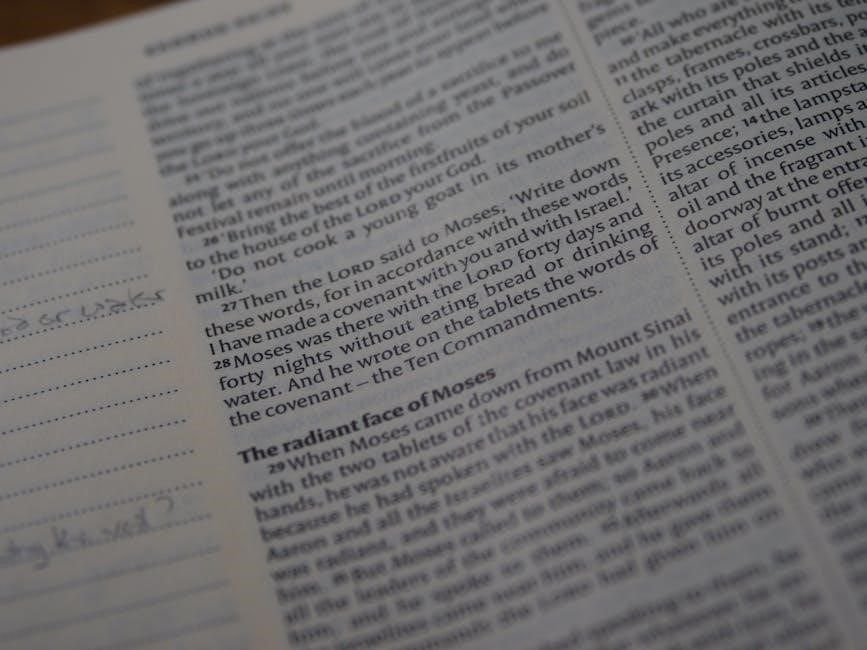
Exodus 16-18 details the Israelites’ journey through the wilderness after leaving Egypt, focusing on God’s consistent provision and the initial establishment of laws. PDF studies emphasize God’s miraculous provision of manna and quail as daily sustenance, demonstrating His care for His people despite their complaints. This section highlights the importance of dependence on God and obedience to His commands.
The giving of the Sabbath law in Exodus 16 underscores the significance of rest and worship. Further laws and ordinances are introduced, establishing a framework for social and religious life within the newly formed nation. PDF resources often analyze these laws in their historical and cultural context.

Jethro’s visit and advice to Moses in Exodus 18 offer practical wisdom regarding leadership and delegation. Jethro suggests appointing capable individuals to assist Moses with judging, easing his burden and improving the administration of justice. This demonstrates the importance of wise counsel and efficient governance.
The Ten Commandments and the Covenant (Exodus 19-24)
Exodus 19-24 narrates the pivotal event of God establishing a covenant with Israel at Mount Sinai. PDF analyses highlight the dramatic theophany – God’s awe-inspiring appearance – and the preparation of the Israelites for this sacred encounter. The core of this section is the giving of the Ten Commandments (Exodus 20), foundational moral and spiritual principles for the nation.
These commandments, often categorized as duties to God and duties to neighbor, form the basis of the Mosaic Law. PDF resources delve into the meaning and implications of each commandment, exploring their relevance for contemporary life. Following the Ten Commandments, God provides further laws and statutes, detailing aspects of worship, justice, and social conduct.
The covenant is sealed with a sacrificial offering and the reading of the Book of the Covenant to the people (Exodus 24). This act symbolizes Israel’s acceptance of God’s terms and their commitment to obedience. PDF studies emphasize the covenant as a reciprocal agreement, outlining both God’s promises and Israel’s responsibilities.
The Golden Calf and its Consequences (Exodus 32-34)
Exodus 32-34 recounts a tragic episode of Israel’s faithlessness while Moses is on Mount Sinai receiving the Law. PDF commentaries detail how, fearing Moses’ prolonged absence, the people demand Aaron create a golden calf to worship – a blatant violation of the first commandment. This act of idolatry provokes God’s righteous anger and a threat to destroy the nation.
Moses intercedes on behalf of the Israelites, pleading for God’s mercy. PDF analyses explore the significance of Moses’ intercession as a foreshadowing of Christ’s mediatorial role. God relents, but judgment is enacted: the idol is destroyed, and the Levites execute those most culpable. This demonstrates the seriousness of covenant breaking.
Exodus 34 describes Moses’ renewed ascent of Sinai to seek God’s continued favor. God reaffirms the covenant, reiterating the Ten Commandments and emphasizing the importance of exclusive worship. PDF resources highlight God’s grace and willingness to forgive, despite Israel’s repeated failures, showcasing His enduring faithfulness.
Instructions for the Tabernacle (Exodus 25-31)
Exodus 25-31 meticulously details God’s instructions to Moses for constructing the Tabernacle – a portable sanctuary symbolizing God’s presence among His people. PDF study guides emphasize the Tabernacle’s design as a microcosm of heaven, reflecting divine order and holiness. These chapters outline specifications for the Ark of the Covenant, the altar of burnt offering, the lampstand, and the table of showbread.
Detailed instructions cover materials – gold, silver, bronze, precious stones, and fabrics – and the skilled craftsmanship required. PDF resources highlight the symbolic meaning of each element, revealing insights into God’s character and purposes. The precise measurements and artistic details underscore the importance of reverence and obedience in worship.
Furthermore, these chapters introduce the roles of the priests and the importance of maintaining ritual purity. PDF commentaries explore the significance of the Tabernacle as a foreshadowing of Jesus Christ, the ultimate dwelling place of God with humanity, offering a deeper understanding of its spiritual implications.
Construction of the Tabernacle (Exodus 35-40)
Exodus 35-40 narrates the actual construction of the Tabernacle, following God’s detailed instructions given to Moses. PDF resources showcase the Israelites’ willing participation, offering their skills and resources for this sacred project. The chapters detail the work of skilled artisans – Bezalel and Oholiab – who led the construction, demonstrating divine empowerment.
The narrative meticulously describes the creation of each component: the Ark, the altar, the curtains, and the priestly garments. PDF study guides emphasize the precision and artistry involved, reflecting the Israelites’ dedication to honoring God. The meticulous adherence to God’s specifications highlights the importance of faithfulness and obedience.
Finally, the book culminates with the Tabernacle’s completion and the glory of the Lord filling it, signifying God’s acceptance and dwelling among His people. PDF commentaries explore the Tabernacle as a symbol of God’s presence and a foreshadowing of the ultimate temple – Jesus Christ – offering a profound understanding of God’s redemptive plan.
Finding Exodus Resources in PDF Format
Numerous PDF resources are available for in-depth study of the Book of Exodus. Online platforms like Bible Gateway, Blue Letter Bible, and various seminaries offer downloadable commentaries, study guides, and articles. These resources provide detailed analyses of the text, historical context, and theological themes.
PDF study guides often include chapter-by-chapter summaries, character studies (like Moses and Pharaoh), and explorations of key events like the Ten Plagues and the Passover. Searching for “Exodus commentary PDF” yields a wealth of scholarly materials, including works by respected theologians.

Furthermore, many churches and Bible study groups create and share their own PDF resources, offering practical applications and devotional insights. Websites dedicated to biblical archaeology and history also provide PDF documents relating to the historical setting of Exodus. Utilizing these resources enhances understanding of this pivotal book, revealing God’s power and faithfulness.



0 Comments